


Graphite iron shafts are lighter, so they can help slower swingers launch the ball higher and they send less vibration into your hands. Steel iron shafts are heavier, and most faster, stronger swingers still find them easier to control. Modern graphite has closed a lot of that gap, though, and some tour players now carry it in their irons. The right answer comes down to your swing speed, your body and how each one feels when you hit it.
What is the real difference between graphite and steel iron shafts?
Weight is the big one. Most steel iron shafts land somewhere around 90 to 135 grams. True Temper lists its Dynamic Gold, one of the most played steel shafts ever, at 127 to 134 grams depending on flex. There are lightweight steel shafts too. Nippon's Zelos 7 weighs just over 70 grams.
Graphite covers a much wider range. The lightest graphite iron shafts sit around 40 to 65 grams, the middle of the market runs about 65 to 95 grams, and heavier graphite built for fast swingers goes from 95 to 120 grams and up. For example, UST's Recoil 460 ES weighs 63 to 67 grams, while Fujikura's Axiom comes in 75, 105 and 125 gram versions.
The other difference is feel. Steel is one solid material and transfers more vibration to your hands. Graphite absorbs more of that shock, so mishits sting less.
Who should play graphite iron shafts?
Graphite usually makes sense if:
- Your swing speed has dropped. KBS chief designer Kim Braly told GOLF.com that golfers whose driver speed has fallen below about 90 mph are good candidates for graphite iron shafts. Treat that as a starting point, not a rule.
- You struggle to get the ball up. A lighter shaft is easier to swing, which can help you launch the ball higher and keep it in the air long enough to hold a green.
- Your hands, elbows or shoulders get sore. Graphite dampens vibration. MyGolfSpy notes that golfers with joint issues or soreness will likely get some benefit from graphite. It is not a medical fix, but a lot of players say it simply feels better at impact.
Plenty of seniors, juniors and women play graphite in their irons for these reasons. Our guide to the best golf clubs for seniors covers lighter sets in more detail.
Who should play steel iron shafts?
Steel tends to suit golfers with faster swings, a quick tempo or a strong transition. The extra weight helps some players feel where the clubhead is and keep their timing and distance control steady. Steel also has a long track record for consistency from one shaft to the next, and it usually costs less. If you already hit your irons high enough and your body feels fine after a round, there is no reason to leave steel.
Has graphite caught up to steel?
Mostly, yes. Older graphite iron shafts had a reputation for being too light, too soft and inconsistent from shaft to shaft. That has changed. In a 2025 GolfLink article, PGA professional Brad Sparrer said many players now see tighter dispersion and better distance control with modern graphite, and that with matched specs the performance difference is minimal, though not zero. Today it is more about personal preference than performance.
Why do most tour players still use steel in their irons?
Tour players swing fast, and they want a heavy shaft that behaves the same way every time. According to the PGA TOUR, most of them play steel iron shafts in the 120 to 130 gram range. Heavier graphite options exist, but there are fewer of them than heavy steel shafts. Habit plays a part too. A tour pro who has played steel his whole career has little reason to change if it still works.
Some pros have made the switch:
- Bryson DeChambeau became the first PGA TOUR player to use graphite shafts in all 14 clubs. He told GOLF.com graphite lowered his iron spin and reduced deflection.
- C.T. Pan moved to 90 gram KBS graphite iron shafts in 2024, saying they were lighter, easier to hit and helped him hit the ball higher.
- Rickie Fowler switched from 125 gram steel to 125 gram AeroTech SteelFiber graphite in 2025, calling it "a little easier on the body" with very similar numbers.
- Matt Kuchar and Brandt Snedeker have played graphite iron shafts for years.
If players that fast can play graphite, it is not only a slow swinger's shaft anymore.
How much more does graphite cost?
Graphite usually costs more. MyGolfSpy puts most steel iron shafts at about $30 to $60 per shaft uninstalled, while graphite iron shafts start around $50 and premium models go past $100 each. There is overlap, so a budget graphite shaft can cost less than a premium steel one. Across a full set of irons the difference adds up, which is one more reason buying used makes sense.
How many used iron sets are graphite vs steel?
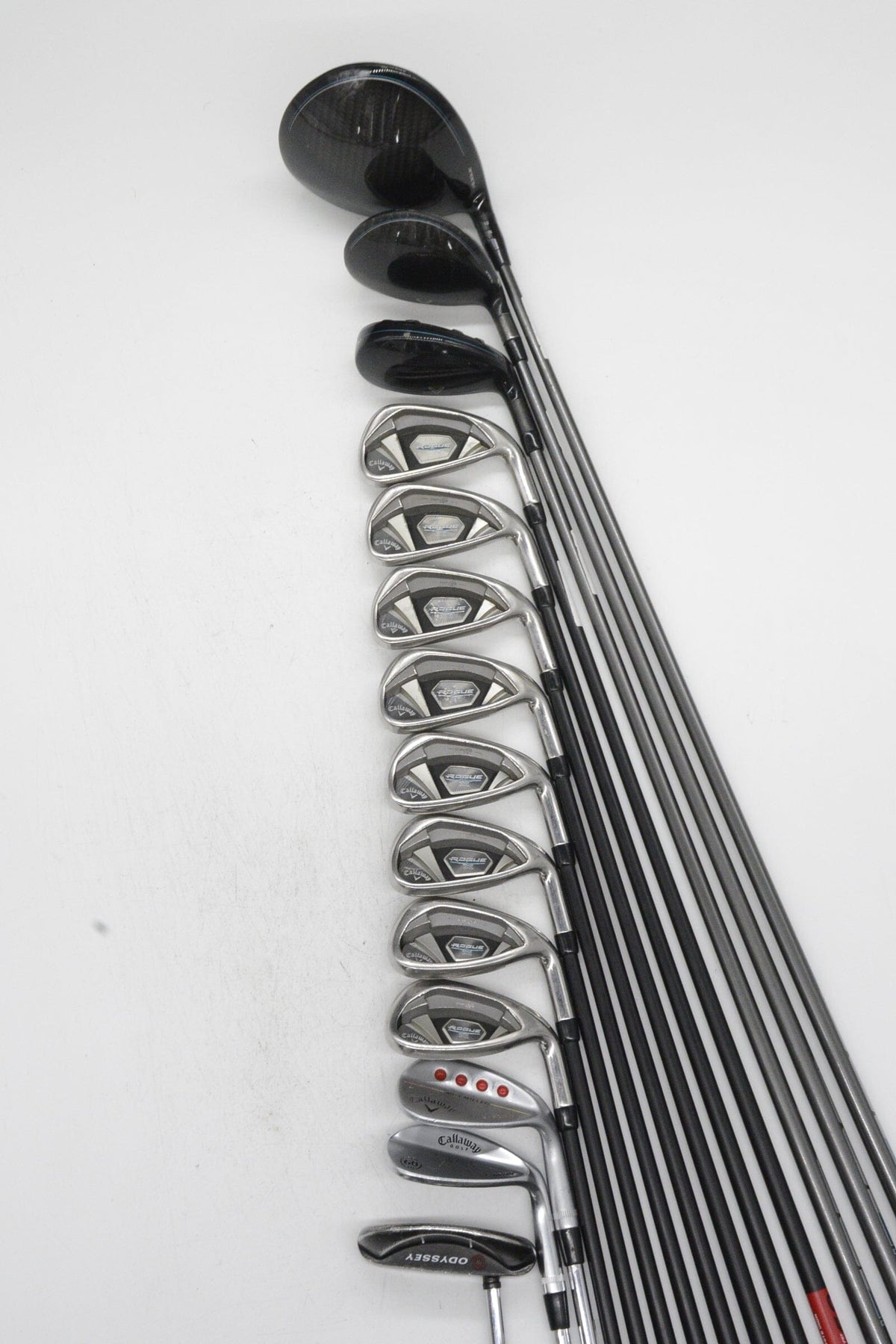
We counted the used iron sets in stock at GolfRoots in November 2026. Out of 622 used sets and partial sets, 413 were listed with steel shafts and 207 with graphite, about two steel sets for every graphite set. So there is plenty of both to choose from. Browse graphite iron sets, steel iron sets or all used iron sets.
How do I test graphite vs steel for myself?
The best test is to hit both. Grab the same model 7 iron in steel and in graphite if you can, with the same flex, and hit five or six balls with each. Pay attention to:
- Height: Does one launch noticeably higher?
- Carry and gaps: Does one carry farther, and does it still give you consistent distances?
- Direction: Does one stay closer to your target line?
- Feel: How do your hands feel after a mishit? How do you feel after 30 balls?
You can do this on the simulator at our Farmers Branch shop at 13260 Josey Ln, Suite 106. We are open Monday to Friday, 8am to 5pm. Pull a few sets off the rack and compare the numbers side by side.
Flex matters as much as material. A graphite shaft in the wrong flex will not help you. Read what shaft flex do I need and how to pick a golf shaft in 3 steps before you decide.
How do I tell shaft type and flex on a used iron set listing?
Our used iron set titles show the flex right in the name, like R Flex or SR Flex. The shaft model and material are in the product details, marked as Graphite or Steel. For example, a used Ping G440 set might list "Ping Alta CB AWT (Graphite)" with Senior Flex. Our guide on how to read a used iron set listing breaks down every part of the title, including flex letters and length.
In person, look at the shaft itself. Graphite is usually painted and smooth. Steel is usually chrome or satin metal and often has visible steps along the shaft, though some steel shafts are smooth and some graphite is made to look like metal. The shaft label or band usually settles it.
Can I switch my irons from steel to graphite?
Yes, by reshafting. You keep the heads you like and swap in new shafts. It costs more than buying a used set that already has the shafts you want, so compare both options. Read reshafting: when and why it's worth it, and see our golf club repair page for reshaft labor pricing. Reshaft labor is $19.99 per club, with the shaft extra.
FAQ
Are graphite iron shafts better for seniors?
Often, yes. Lighter graphite can help slower swing speeds launch the ball higher and is easier on the joints. It is still worth hitting both, since some seniors swing steel just fine.
Do graphite iron shafts go farther than steel?
They can for some players, because a lighter shaft may let you swing a bit faster and launch the ball higher. It is not guaranteed. Faster swingers may see no gain, or less control.
How much do steel iron shafts weigh?
Most weigh roughly 90 to 135 grams. True Temper's Dynamic Gold is 127 to 134 grams depending on flex, and lightweight steel like the Nippon Zelos 7 is just over 70 grams.
Do any tour pros play graphite irons?
Yes. Bryson DeChambeau, Rickie Fowler, C.T. Pan, Matt Kuchar and Brandt Snedeker have all played graphite iron shafts on the PGA TOUR. Most tour players still use steel.
Can I mix graphite and steel in my bag?
Yes. Most golfers already do, with graphite in the driver, woods and hybrids and steel in the irons. What matters is that the shafts within your iron set match each other.