
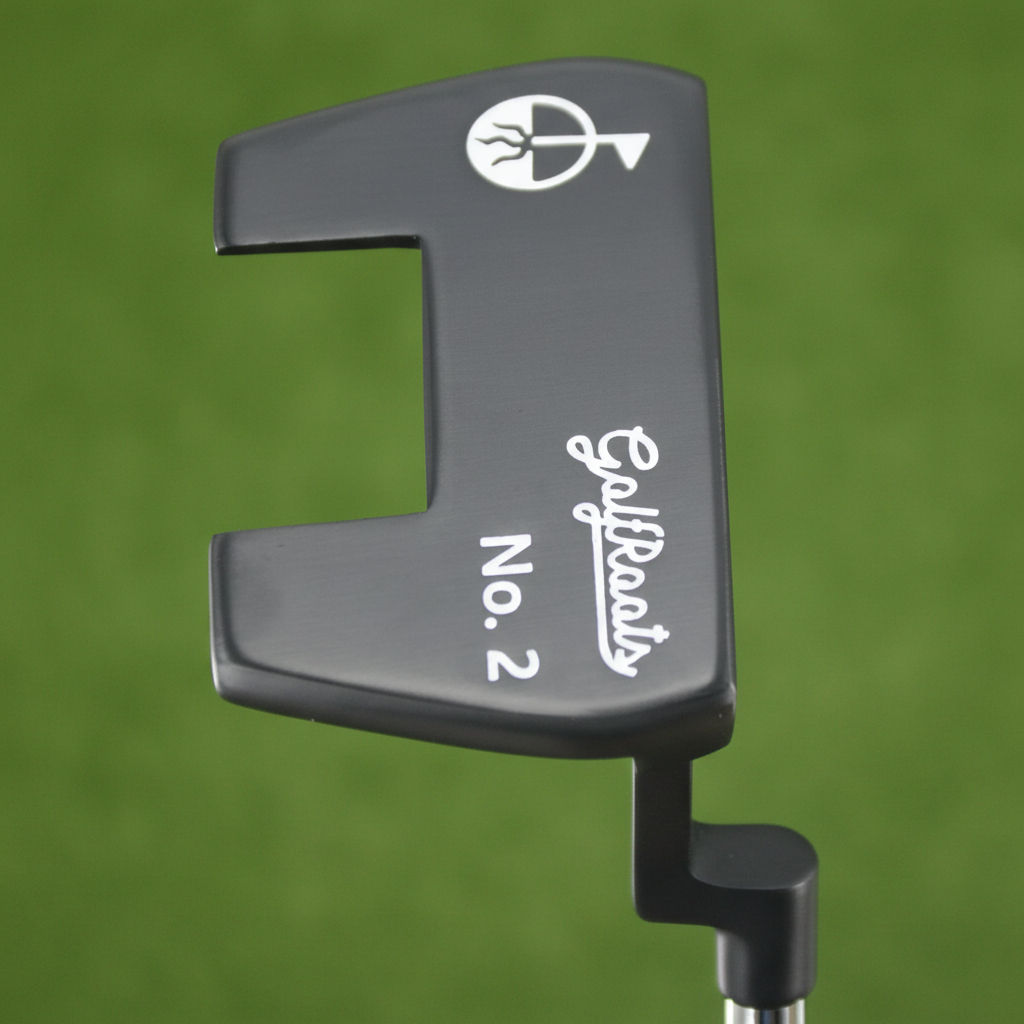


Choose a mallet putter if you want the most forgiveness and help lining up, or your stroke stays fairly straight. Choose a blade if your stroke swings on a gentle arc and you like a compact head with clear feedback on where you hit it. Neither one makes putts by itself. The right putter is the one that fits your stroke, your eye and your setup.
We have hundreds of used blades and mallets in the shop, so here is how we would think through the choice, plus what each style actually costs used at GolfRoots right now. If you are deciding between two specific Scotty Camerons, our Newport 2 vs Phantom comparison goes deeper on that one matchup.
What is the difference between a blade and a mallet putter?
A blade is a narrow head that is short from front to back. Most modern blades are some version of the heel-toe weighted design Ping introduced with the Anser in 1966 (read the Ping Anser story). A mallet is a larger head that extends well behind the face, from a small half-moon shape up to the big winged and framed designs you see on modern models.
The size difference matters because of where the weight can go. A mallet can push weight to the back and the edges of the head. A blade keeps most of its weight in a line near the face.
What does MOI mean for a putter, and why are mallets usually more forgiving?
MOI stands for moment of inertia. For a putter, it describes how much the head resists twisting when you hit the ball off the center of the face. The higher the MOI, the less the face turns on a mishit, which keeps the ball closer to your line and the speed more consistent.
Mallets are usually more forgiving because their larger heads can spread weight farther from the center. That generally gives them a higher MOI than a traditional blade. It is not an absolute rule, though. Some wider blades are built with more stability than older blades, so a mallet is not the only way to get help on mishits.
Keep MOI in perspective. Think of it as insurance for the putts you miss off the toe or heel. A high MOI putter will not fix a stroke that is aimed wrong or a bad read.
Which putter fits my stroke: toe hang or face balanced?
This is the part most golfers skip, and it is the most useful thing to know before you buy. The common guidance goes like this:
- Arcing stroke. If the putter swings slightly inside on the way back and the face opens and closes through the stroke, a putter with some toe hang usually suits you. Most blades have toe hang. A bigger arc tends to pair with more toe hang, and a small arc with a little.
- Straight back, straight through. If your putter moves on a fairly straight line with little face rotation, a face-balanced putter is the usual match. Most mallets are face balanced.
How to check a putter: balance the shaft on your finger, close to the head, so the shaft sits level. If the face points straight up at the sky, the putter is face balanced. If the toe drops toward the ground, it has toe hang, and the more it drops, the more toe hang it has.
A few honest caveats. Every stroke has some arc, so this is a matter of degree. The neck and shaft bend control toe hang as much as head shape does, which is why you can find toe-hang mallets and nearly face-balanced blades. Your miss pattern is a clue too: golfers who push putts often do better with less toe hang, and golfers who pull putts may like more. Treat all of this as a starting point, not a law. The goal of any putter is to get the face square at impact.
Do alignment aids make a difference?
For a lot of golfers, yes. If you often feel like you are aimed left or right when you stand over a putt, a head with strong lines or shapes on top can help you set the face square. Mallets have more room for these aids. The Odyssey 2-Ball puts two ball-sized circles behind the face (see our 2-Ball history), and TaylorMade's Spider line built its True Path alignment around long sightlines (see where True Path came from).
Blades keep it simple, usually a single sightline or a dot, or nothing at all. Some players find a clean blade easier to aim because there is less to look at. Stand over a few of each and notice which one looks square to you without fiddling.
How much do feel and sound matter?
More than people expect, because feel and sound are how you judge speed. A soft insert, like Odyssey's White Hot, gives a quieter, more muted feel off the face (more in what is behind the White Hot feel). A milled steel face gives a firmer, clicky feel that many better players like for feedback. Both blades and mallets come with either kind of face, so pick the head shape for your stroke and the face for your ears and hands.
What length putter do I need?
Length affects your setup more than any head shape does. Many men's putters come in 34 or 35 inches, and many women's putters in 33 inches, but those are just stock sizes. At address, you want a comfortable bend from the hips, arms hanging naturally, and your eyes roughly over the ball or just inside it. One simple check: hold a ball at the bridge of your nose and drop it. If it lands inside the ball on the ground, a shorter putter may help. If it lands outside, you may need a little more length.
A putter that is too long often has you standing too upright, and one that is too short makes you crouch. Every GolfRoots listing shows the length in the title, and we can lengthen or shorten a putter in the shop. Read should you lengthen or shorten your golf clubs or see our repair and regripping prices.
Does putter grip size matter?
Yes, and it is an easy change. Putters are the only clubs allowed a grip that is not round, which is why putter grips come in flat-front pistol shapes and in fatter, more oversized styles. A thick grip and a thin grip feel very different in your hands, so it is worth trying both. Our guide to what size golf grip you need covers sizing, and a used putter with a worn grip is a quick fix in the shop.
How should I test a blade vs a mallet?
- Start on a putting green (ours or your course's practice green). Roll the same three putts with each putter: a 5 footer, a 15 footer and a long lag. Watch where the short ones start and how close the long ones finish.
- Hit a few off the toe and heel on purpose. This is where you will feel the difference in forgiveness.
- Do the balance test on each putter so you know which one has toe hang.
- Check your setup with each length you try.
If you are near Dallas, come by our showroom at 13260 Josey Ln, Suite 106, in Farmers Branch, Monday to Friday, 8am to 5pm. We have a putting green in the shop, so you can roll blades and mallets side by side, run these same tests and check the toe hang yourself. Online orders come with our 60-day return policy. See our Dallas showroom page for directions.
What do used putters cost at GolfRoots?
Here is what we found in our own in-stock listings in November 2026. These are listing prices for individual used putters at standard lengths, and they change as putters sell and new ones come in.
- Blades vs mallets overall. We had about 736 blades and 477 mallets in stock. Roughly 58% of the blades were under $100, compared with about 37% of the mallets, so a good used blade is usually the cheaper place to start.
- Ping Anser-style blades: most from $53.99 to $149.99 (Anser 2, 3, 4, Karsten, Cadence and Sigma models). Milled PLD Anser models ran $329.99 to $369.99.
- Odyssey White Hot blades (#1, #9, Pro 1, XG): $59.99 to $149.99, with most between $59.99 and $89.99.
- Odyssey White Hot mallets (Rossie, Sabertooth, V-Line, Marxman, 2-Ball and others): $54.99 to $149.99, with most under $90.
- Odyssey 2-Ball models: $53.99 to $149.99, from older DFX and White Hot XG versions up to Ai-ONE.
- Scotty Cameron Newport family (blades): $179.99 to $699.99. Select, Studio Select, Special Select and Pro Platinum Newports mostly ran $239.99 to $359.99. Studio Style and Super Select models ran $299.99 to $439.99, and limited runs and Teryllium versions went higher.
- Scotty Cameron Phantom (mallets): Phantom X models from $199.99 to $379.99, 2024 models from $269.99 to $399.99, and 2026 models from $429.99 to $499.99.
- TaylorMade Spider (mallets): older Spider models like the Ghost Spider, Spider Tour Red and Spider SR from $47.99 to $139.99. Spider Tour S, Tour X and GTx models ran $169.99 to $299.99, and the newest Spider ZT models $319.99 to $369.99.
Within the same brand and era, a blade and a mallet usually cost about the same. The bigger price jump comes from the brand and how new the model is. For budget picks, see the best used putters under $100. If you have your heart set on a Cameron, read where to buy a used Scotty Cameron putter. Or browse every used putter we have in stock, each listed with its exact length and a 1 to 10 condition grade.
Is a blade or mallet better for beginners?
For most beginners, a face-balanced mallet is the easier start. It is more forgiving on mishits, easier to aim, and plenty of good ones cost under $100 used. That said, if you pick up a blade and it just looks right to you, putt with it. Confidence over the ball counts for a lot.
Want to know how we got from the first blades to today's high-MOI mallets? Read the history of the putter.
FAQ
Are mallet putters more forgiving than blades?
Generally, yes. Mallets can place weight farther from the center of the face, which usually gives them a higher MOI, so they twist less on off-center putts. Some wider modern blades close the gap.
How do I know if I have an arc stroke?
Put a club or alignment stick on the ground along your target line and make some strokes. If the putter head drifts inside the line on the way back and through, you have an arc. If it stays close to the line the whole way, your stroke is fairly straight.
Can I try putters before I buy at GolfRoots?
Yes. Our Farmers Branch shop has a putting green, so you can roll any putter in stock before you buy, Monday to Friday, 8am to 5pm.
Can a mallet have toe hang?
Yes. Toe hang depends on the neck and shaft as much as the head, and some brands now make toe-hang mallets for golfers who have an arc but want a bigger, more stable head.
Do I need a new putter or just a different length?
Sometimes length is the real problem. If you feel cramped or too upright at address, try fixing the length first. We can lengthen or shorten a putter in the shop.
Is a used putter a good buy?
Usually, if you check it over first. Look at the face for deep dings, make sure the shaft is straight, and plan on a new grip if the old one is worn.