


The golf driver started as a long-nosed wooden "play club" carved by hand in Scotland, moved to persimmon around 1900, went metal in 1979, oversized with Callaway's Big Bertha in 1991, and has been capped by USGA limits on size and spring since the early 2000s. Since then, progress has come from forgiveness and adjustability, not raw distance. That last part matters a lot if you are buying a used driver.
What were the first golf drivers made of?
The earliest drivers were called play clubs: long, shallow wooden heads spliced onto hickory shafts. Hugh Philp of St Andrews, who started making clubs in 1812 and became clubmaker to the Society of St Andrews Golfers in 1819, is the name collectors know best. His heads were thorn, apple or pear, and beech was common too. Philp's clubs were prized enough that forgeries were made in his own lifetime.
Why did drivers change in the 1800s?
The ball changed. The gutta-percha "gutty" ball began replacing the feather-stuffed ball around 1848. It was much harder, and it broke the delicate long-nose heads, so clubheads got shorter and sturdier over the following decades. Around 1885, the bulger driver added a convex face to reduce curve on off-center hits, an idea usually credited to Henry Lamb. That curve, called bulge, is still on every driver face today.
Then came persimmon. Crawford, McGregor & Canby, later MacGregor, entered golf in 1897 and was the first to use persimmon at scale. By 1900 it was shipping around 100,000 machine-turned persimmon heads a year to Britain. Persimmon's interlocking grain resisted splitting far better than beech. The rubber-cored Haskell ball, patented in 1898 and 1899, arrived around the same time. Sandy Herd won the 1902 Open with one.
When did steel and graphite shafts arrive?
Steel shafts were legalized by the USGA in 1924 and by the R&A in 1929. Graphite came much later. Frank Thomas developed it at Shakespeare and unveiled it at the 1970 PGA Merchandise Show, when graphite fiber cost about $500 a pound. It did not become standard in drivers until the 1990s.
What was the golden age of persimmon?
The late 1940s and 1950s. MacGregor's Tommy Armour deep-face drivers and Tourney Eye-O-Matic models, with their screwed-in face inserts, were played by Hogan, Nelson, Palmer and Nicklaus. Laminated maple heads were the cheaper, more stable alternative. If you see a persimmon driver in our classic clubs, this is the family tree it comes from.
Who made the first metal driver?
Not TaylorMade, despite what you often hear. Metal-head patents go back to the 1920s, and Pinseeker sold a stainless "Bombshell" wood in 1976. What Gary Adams did in 1979 was make the first commercially successful one: TaylorMade's stainless steel "Pittsburgh Persimmon," built in McHenry, Illinois. Ron Streck won the 1981 Houston Open with it, and Lee Trevino's 1984 PGA Championship was the first major won with a metal driver. By the mid-1980s, metal had won the market.
How did drivers get so big?
Callaway launched the Big Bertha in January 1991: stainless steel, 190cc, named after a World War I howitzer. It sold about $54 million in its first year. Titanium followed. Mizuno's Ti-110 in 1990 was the first titanium driver, mostly sold in Japan, and Callaway's 253cc titanium Great Big Bertha in 1995 took it mainstream. By the early 2000s, heads had grown past 400cc.
What limits do the rules put on drivers?
- Spring-like effect (COR): the USGA set a 0.830 limit in 1998. After a compromise with the R&A, 0.830 has applied to everyone worldwide since January 1, 2008. Since 2004 it has been measured with a pendulum test, called characteristic time (CT).
- Head size: 460cc maximum since 2004.
- Moment of inertia: capped at 5,900 g-cm² from May 2006.
- Length: 48 inches maximum. A 2022 local rule lets elite events cap drivers at 46 inches. It does not apply to everyday golfers.
- Adjustability: allowed for clubs submitted from January 1, 2008.
What has changed since the limits?
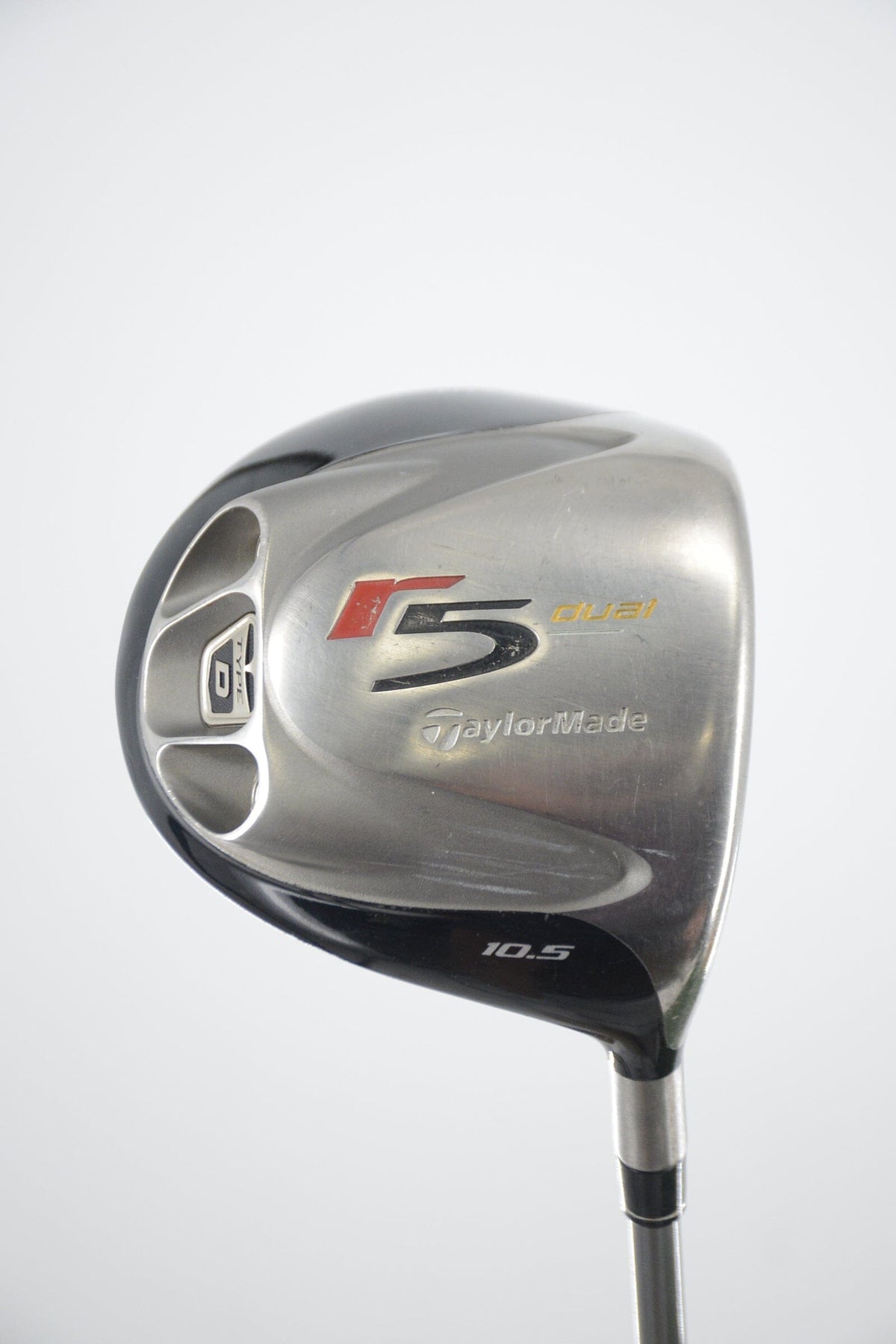
Designers could no longer add spring, so they chased forgiveness and fit. TaylorMade's r7 Quad (2004) was one of the first drivers with movable weights, and the R9 (2009) popularized adjustable hosels alongside several rivals. Carbon crowns saved weight to push the center of gravity low and back, as in TaylorMade's M1 (2015). Callaway's Epic Flash (2019) used machine learning to design its face, which Callaway called a first for the golf equipment industry. TaylorMade's Stealth (2022) was the first mainstream driver with a carbon face. We cover several of these in our spotlights: the RocketBallz, M4, Callaway Epic and Qi10.
What does this history mean for buying a used driver?
Here is our take. Any conforming driver made since 2008 sits under the same limit on face spring, and anything since 2004 is 460cc or smaller. So a well-fit driver from five or ten years ago is not dramatically shorter on a center strike than this year's model. What newer drivers mostly add is more ball speed on mishits, higher forgiveness, and more adjustability. For a lot of golfers, a used driver from a few generations back, with the right loft and shaft flex, is the best value in golf. You can browse ours in used drivers, and read what wears out on used clubs and what doesn't.
FAQ
Why is a driver called a driver?
It was originally called the play club. "Driver" simply describes its job: driving the ball off the tee.
When did drivers stop being made of wood?
Metal took over through the 1980s after TaylorMade's 1979 Pittsburgh Persimmon. By the early 1990s, persimmon was rare on tour.
What is the biggest driver head allowed?
460cc, with a small tolerance, since 2004.
Is an older driver still legal?
Most are. A few pre-2008 models exceeded the spring-like effect limit and are not conforming for competition. The USGA publishes a list of non-conforming drivers.
By Benjamin Stromberg, Co-Founder, GolfRoots. Sources: USGA equipment notices, Golf Digest, Golf Channel, Global Golf Post, GolfWRX, Scottish Golf History, The Open.