



The modern wedge started with Gene Sarazen in 1932. He added solder to the sole of a niblick so it would bounce off sand instead of digging, hid the club from officials and won the Open Championship at Prince's that summer. Since then wedges have gained bounce options, sole grinds, new lofts like the lob and gap wedge, and grooves regulated by the rules. Here's how we got from one homemade club to a bag with three or four wedges.
Who invented the sand wedge?
Gene Sarazen gets the credit for the modern sand wedge, though he wasn't the first to try a sand club. In 1928 E.K. McClain patented a concave-faced "sand niblick," and Bobby Jones used one in 1930. The R&A banned concave faces in 1931, so golfers were back to playing bunker shots with a plain niblick, a short, lofted iron with a sharp leading edge that dug into sand.
Sarazen's idea, as he told it, came while Howard Hughes was teaching him to fly: the way the plane's tail surfaces moved made him think of a club that would lift through sand. At his home in New Port Richey, Florida, he got a batch of niblicks from Wilson and used solder to build up the back of the sole, creating a flange that sat below the leading edge. That was bounce.
He was worried the club would be ruled illegal, so at the 1932 Open at Prince's he reportedly kept it hidden in his bag when he wasn't using it. He won the Open and then the U.S. Open the same year. He later donated the club to the USGA Museum, where it measures about 58.5 degrees of loft and 13.5 degrees of bounce, numbers that would fit right into a modern bag.
What is bounce on a wedge?
Bounce is the angle between the leading edge and the lowest point of the sole (or trailing edge). More bounce keeps the leading edge up so the club skids through sand and soft turf. Less bounce lets the edge get under the ball on tight, firm lies. Our wedge bounce guide explains how to choose.
How did Cleveland change wedge design?
Roger Cleveland founded Cleveland Classics in 1979 and unveiled the 588 wedge in 1988. The 588 became one of the most popular wedges ever and helped make sole shape, not just loft, part of how golfers shop for wedges. The company was sold to Rossignol in 1990, and Roger Cleveland left in late 1995. He spent the next 28 years designing at Callaway before returning to Cleveland Golf as founder and advisor in March 2025. That June, J.J. Spaun won the U.S. Open at Oakmont with three Cleveland wedges in the bag.
Where did the lob wedge come from?
Short game coach Dave Pelz pushed the idea of a fourth wedge with around 60 degrees of loft in the 1980s, and Tom Kite was one of the early tour players to carry one. Kite had it in the bag when he won the 1992 U.S. Open at Pebble Beach.
Why do golfers need a gap wedge?
Pitching wedge lofts got stronger as irons got more forgiving and distance became the selling point, dropping from around 50 to 52 degrees to 45 to 48 degrees in many sets. That left a gap of 8 to 10 degrees, sometimes 30 to 40 yards, between the pitching wedge and a 56-degree sand wedge. The gap wedge (also sold as an approach or attack wedge) fills it. Check your pitching wedge loft before you buy wedges so the gaps stay around 4 to 6 degrees.
How did the high-toe wedge start?
At the 2014 PGA Championship at Valhalla, Phil Mickelson played a prototype wedge with a high toe built by Roger Cleveland at Callaway, reshaping a Mack Daddy 2 with input from Mickelson, who liked the shape of his old Ping Eye 2 lob wedge. It became the Mack Daddy PM Grind, sold from May 2015, and other brands followed with their own high-toe designs.
What did the 2010 groove rule change?
Starting January 1, 2010, the USGA and R&A limited groove volume and edge sharpness on new irons and wedges to reduce spin from the rough. The detail most golfers miss: the stricter grooves are required only in competitions that adopt Model Local Rule G-2, which covers the professional tours, USGA and R&A championships and some elite amateur events. For casual golf, handicap rounds and most club events, older wedges with pre-2010 grooves are still fine to use. The governing bodies have said those clubs remain allowed until at least 2024 and that any change will come with years of notice, and none has been set. So a used pre-2010 wedge is not illegal for most golfers. What matters more is how worn its grooves are.
The 2010 rule also reopened an old fight. Read the Ping Eye2 lawsuit.
What are wedge grinds?
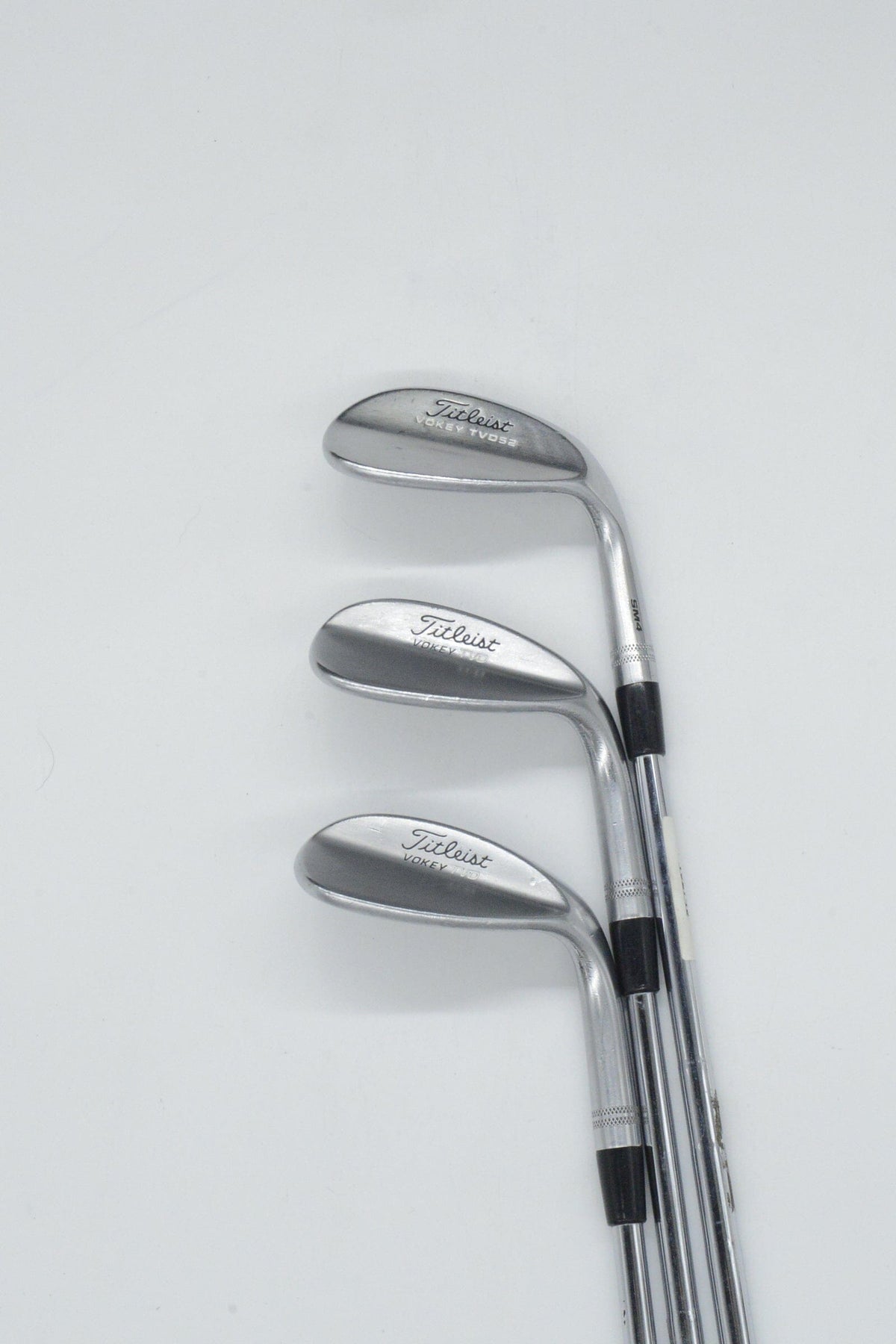
A grind is the shape of the sole: how much material is removed from the heel, toe and trailing edge. Grinds change how the club sits when you open the face. Titleist's Vokey line, led by Bob Vokey since he took over Titleist's wedge program in 1996, popularized letter-named grinds (like F, S, M, L and D), and Titleist says Vokey has been the most played wedge on the PGA Tour since 2004 based on the Darrell Survey. Callaway's JAWS MD5 (2019) and Cleveland's RTX and RTZ lines push groove precision and face texture for spin.
What should you look for in a used wedge?
- Groove wear. Wedges wear faster than any other club. Run a fingernail across the grooves; if they feel smooth near the center, spin will be down.
- Bounce and grind for your conditions. More bounce for soft sand and steep swings, less for firm turf and shallow swings.
- Loft gaps. Match your pitching wedge, then space wedges 4 to 6 degrees apart.
- Raw faces are normal to rust. Rust on a raw wedge is by design, not damage.
Shop used wedges, used Cleveland wedges and used Vokey SM9 wedges. More from our history series: the driver, the iron and the putter.
Not sure which wedge shot to play? Read chip vs pitch in golf.
FAQ
Did Gene Sarazen invent the sand wedge?
He created the modern sand wedge with bounce in 1932. Earlier concave sand clubs existed but were banned in 1931.
Are pre-2010 wedges illegal?
Not for most golfers. The 2010 groove limits apply only in competitions that adopt the groove Local Rule, mainly professional and elite events.
How often should I replace my wedges?
It depends on how much you play and practice. Frequent players and anyone who hits a lot of bunker shots wear grooves quickly, so check them every season.
How many wedges should I carry?
Most golfers do well with a pitching wedge plus two or three more, for example 50, 54 and 58 degrees, depending on their pitching wedge loft.
Next in our history series: the history of fairway woods and hybrids.